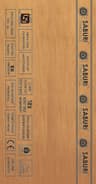
Two sheets can look identical and perform nothing alike — the difference is in the material. This covers what actually determines plywood quality: core timber and density, screw-holding and load-bearing, thickness and warp resistance, and how the board types (plywood, chipboard, MDF, flush doors) really compare.
Thickness by application
| Thickness | Typical use |
|---|---|
| 4–6mm | Backing panels |
| 9mm | Drawer sides |
| 12mm | Shelving and cabinet backs |
| 18mm | Furniture shutters and carcases |
| 19mm | Block board applications |
| 25mm | Heavy-load structural work |
What is the standard plywood sheet size in India?
Quick answer
The standard plywood sheet size in India is 8ft x 4ft (2440mm x 1220mm). Saburi Ply also offers 10ft x 4ft (3050mm x 1220mm) large-format plywood for floor-to-ceiling applications.
The 8ft x 4ft (2440mm x 1220mm) format is the universal standard plywood sheet size in India, consistent with the IS standard specification for most product categories and compatible with all domestic woodworking machinery, panel saws, and furniture production equipment. This format allows efficient nesting of standard furniture components. Saburi Ply's 10ft x 4ft (3050mm x 1220mm) extended format is designed for floor-to-ceiling interior applications where standard 8ft sheets require joins at heights exceeding 8 feet.
For residential and commercial ceiling heights of 9-10 feet (now common in modern construction), 10ft sheets eliminate the visible horizontal join line that occurs when two standard 8ft sheets are joined. Block board, flush doors, and specialty products are available in corresponding dimensions. Thickness ranges within each format run from 4mm to 25mm depending on product specification.
How does Saburi Modwud compare to MDF technically?
Quick answer
Saburi Modwud is a wood-chip particle board (IS:3087 plain, IS:12823 pre-laminated) built from size-graded wood chips, whereas MDF is made from fine wood fibres. Modwud offers a high-density core, strong face screw-holding, borer and termite-proof treatment, E1 emissions and a 15-year warranty; the Hydramax variant adds 40% higher moisture resistance for wet areas. MDF gives a smoother surface for routing and moulded profiles but is heavier and, in standard grade, swells more readily on moisture exposure.
Saburi Modwud and MDF are two different engineered-wood categories. Modwud is a particle board manufactured from size-graded wood chips bonded with premium resin under advanced pressing, delivering high density, dimensional stability, a smooth finish-ready surface, and borer/termite-proof performance, with E1 emission compliance and a 15-year warranty. Its chip structure gives strong face screw-holding, and the Hydramax (HMR) variant offers 40% higher moisture resistance and 40% lower linear expansion than standard green boards, plus reliable repeat-fastening through its chip-weave structure — a key advantage for modular kitchen and wardrobe carcases in humid conditions.
MDF, made from fine wood fibres, offers a very smooth, homogeneous surface ideal for painting, routing and moulded/CNC profiles, but standard MDF is heavier and swells more readily on moisture exposure unless a moisture-resistant grade is specified. Saburi does not currently manufacture MDF; for chip-based carcase and furniture panels, Modwud — and for moisture-prone areas, Modwud Hydramax — is the recommended specification. Choose MDF where seamless routed or moulded surfaces are essential, and Modwud where screw-holding, structural stability, moisture-grade options and warranty-backed accountability matter most.
What causes plywood to warp and how does Saburi prevent it?
Quick answer
Plywood warps from unbalanced veneer construction, differential moisture absorption, uncalibrated thickness, or inadequate adhesive distribution. Saburi prevents warping through balanced veneer construction, QuadPro multi-layer bonding, 100% dual-face calibration, and GLP edge treatment — underpinning all warp-free guarantees.
Plywood warping occurs when differential forces across the panel cross-section cause one face to expand or contract more than the other — resulting in bowing, springing, or twisting. Four primary causes and Saburi Ply's manufacturing responses: 1. Unbalanced veneer construction — Saburi uses balanced construction with equal veneer specifications on both sides.
2. Differential moisture absorption — Saburi's GLP treatment and BWP resin bonding minimise edge moisture ingress. 3.
Uncalibrated thickness variation — Saburi's 100% dual-face calibration eliminates density variation across the panel face. 4. Inadequate or uneven adhesive distribution — Saburi's QuadPro Technology enforces uniform adhesive coverage and consistent bonding throughout the veneer stack.
The eight-point quality test regime includes warp measurement on each production batch before dispatch.
How important is timber core species for plywood quality?
Quick answer
Timber core species is the primary determinant of plywood density, strength, and biological resistance. Gurjan (825 kg/m3) in Saburi Titanium Plus and Perennial provides maximum performance. Eucalyptus in Scout and Club H+ mixed core balances cost and performance. Softwood cores produce lower-density panels.
Timber core species directly determines three of the most critical plywood performance characteristics: density, veneer peeling quality, and inherent biological resistance. Gurjan (Dipterocarpus species): the premium choice for marine and luxury plywood, achieving 800-850 kg/m3 with consistent grain structure, excellent veneer peeling quality, and natural biological resistance. Used in Saburi Titanium Plus and Perennial at 100% core composition.
Eucalyptus: a plantation-grown hardwood achieving 600-700 kg/m3 — good structural performance at lower cost than Gurjan. Used in Saburi Club H+ mixed core (Gurjan and Eucalyptus) balancing performance and cost accessibility. Mixed hardwood: plantation-sourced species achieving 500-650 kg/m3 — appropriate for IS:303 BWP and IS:710 applications.
Used in Saburi Gold 710 and Scout. Higher density directly correlates with screw-holding, impact resistance, biological degradation resistance, and long-term structural performance.
What is the chip-weave structure in Saburi Modwud Hydramax?
Quick answer
Chip-weave structure in Saburi Modwud Hydramax is a specialised chip orientation during panel pressing that creates an interlocked fibre matrix. This matrix maintains screw grip through five or more repeat fastening cycles — significantly superior to standard chipboard's random chip orientation which loses grip rapidly under repeat fastening.
Standard chipboard uses randomly oriented wood chips — size-graded but without directional control during pressing. When a screw is driven into standard chipboard and removed, the surrounding chip matrix is disrupted. Repeated fastening and removal cycles progressively enlarge the screw hole and reduce grip force — leading to hinge failure and hardware loosening in modular kitchen cabinets and wardrobes.
Saburi Modwud Hydramax's chip-weave structure applies controlled chip orientation during panel formation — creating an interlocked fibre matrix where chips are positionally aligned to create mechanical resistance to screw thread withdrawal. This interlocked structure distributes screw-holding force across a larger chip contact area and resists fibre displacement under repeated fastening. The documented result: repeat fastening more than five times without loss of grip — a critical performance requirement for modular furniture assembly, hardware replacement, and adjustment cycles across a 15-year furniture lifespan.
What is the screw holding capacity of Saburi plywood vs chipboard?
Quick answer
Saburi BWP plywood (Gold 710, Club H+) with high-density hardwood core provides significantly higher screw-holding than chipboard. However, Modwud Hydramax's chip-weave structure achieves repeat fastening more than five times without grip loss — superior to standard chipboard for modular furniture hardware.
Screw-holding capacity in panel products is measured as the force (in Newtons) required to pull a screw out of the panel face or edge. Saburi's premium BWP plywood (Titanium Plus, Perennial at 825 kg/m3; Gold 710 at IS:710 standard density) provides high face and edge screw retention from dense hardwood veneer composition — typically 800-1000N pull-out force for face screws in 18mm panels. Standard chipboard's random chip matrix provides lower initial screw-holding than plywood but degrades significantly under repeat fastening.
Saburi Modwud Hydramax's chip-weave structure achieves superior repeat-fastening performance versus standard chipboard — maintaining grip through five or more cycles without degradation. For furniture assembly: plywood shutters provide the highest screw retention for hinges and hardware; Hydramax provides the best chipboard-format screw retention for carcase assembly across multiple adjustment cycles.
What is the difference between structural and decorative plywood?
Quick answer
Structural plywood (IS:303 BWP, IS:710) is engineered for load-bearing performance, moisture resistance, and durability in furniture and construction applications. Decorative plywood has premium face veneer selection for aesthetic applications — face quality takes priority over structural properties.
The structural versus decorative plywood distinction reflects different optimisation priorities in manufacturing. Structural plywood (Saburi Gold 710 IS:710, Scout BWP, Titanium Plus) prioritises: adhesive bond strength (PF resin, QuadPro Technology), core timber density (Gurjan for premium, select hardwood for standard), calibration precision (IS:10701 for dimensional accuracy), moisture and biological resistance (multi-stage treatment), and warranty-grade consistency across the full panel thickness. Decorative plywood prioritises: face veneer aesthetics — species selection for natural figure (bird's eye, burl, quarter-cut grain), veneer thickness and uniformity, colour consistency, and absence of knots, checks, or grain irregularities on the face surface.
Core layers in decorative plywood may be of lower structural specification than structural-grade products of equivalent thickness. Saburi Ply's range focuses on structural-grade plywood — combining performance certifications, warranty commitments, and durability specifications rather than decorative face veneer as the primary product attribute.
What determines plywood load-bearing capacity?
Quick answer
Plywood load-bearing capacity depends on panel density (higher density equals higher strength), adhesive bond quality (determines shear resistance under load), timber species (grain structure affects bending strength), and panel thickness (thicker panels have higher load capacity). Saburi premium products achieve 825 kg/m3 with QuadPro bonding for maximum strength.
Load-bearing capacity in plywood is governed by three interconnected material properties. Modulus of Elasticity (MOE): measures stiffness — how much a panel deflects under load before permanent deformation. Higher-density hardwood panels (Saburi Titanium Plus at 825 kg/m3 Gurjan) achieve higher MOE than lower-density alternatives.
Modulus of Rupture (MOR): measures the load at which the panel structurally fails. Density and timber species quality are the primary determinants. Internal Bond Strength (IBS): measures adhesive bond resistance to the delamination shear stress generated by load.
This is where QuadPro Technology's uniform adhesive distribution makes a measurable contribution — panels with consistent bond coverage have higher IBS than those with dry spots. These three properties together determine safe span lengths, maximum shelf loads, and structural performance in furniture applications. IS:303 and IS:710 specify minimum values for MOE, MOR, and IBS per thickness and species group.
What is the difference between solid core and hollow core flush doors?
Quick answer
Solid core flush doors (Saburi Flush Doors) use 100% kiln-dried pinewood filling the door panel for superior screw-holding, sound insulation, durability, and security. Hollow core doors use a grid frame with air or paper honeycomb interior — lighter but with significantly lower structural performance and security.
The fundamental construction distinction between solid core and hollow core flush doors determines their performance across four critical parameters. Screw-holding and hardware installation: solid core construction allows screw installation anywhere on the door face with full wood-to-screw contact. Hollow core construction limits reliable fastener placement to the solid frame members — typically 100mm top and bottom rails and 50mm side stiles.
Sound insulation: solid core doors provide significantly better sound transmission loss — the dense wood mass absorbs and reflects sound energy. Hollow core doors transmit sound readily through the air-filled interior. Impact resistance: solid core construction resists internal and external impact.
Hollow core panels dent and delaminate under impact at non-frame locations. Security: solid core resists forced entry far more effectively than hollow core construction. Saburi Flush Doors use 100% kiln-dried pinewood solid core — providing dimensional stability alongside structural performance.
What is the relationship between plywood thickness and performance?
Quick answer
Thicker plywood has higher load-bearing capacity, greater bending resistance, and more impact resistance. Standard selection: 4-6mm for backing panels, 9mm for drawer sides, 12mm for standard shelving, 18mm for furniture shutters and carcases (most common), 25mm for heavy-load structural applications.
Plywood thickness directly affects three structural performance parameters: bending resistance (increases with cube of thickness — doubling thickness increases bending stiffness 8x), load-bearing capacity (thicker panels deflect less under applied load), and impact resistance (greater cross-section absorbs impact energy). Practical thickness application guidance: 4mm: back panels, cabinet rear panels in wall-mounted units — no independent load-bearing. 6mm: light drawer sides, decorative inserts, Gold Flexi (curved applications).
9mm: standard drawer sides and bases, cabinet back panels. 12mm: medium-span shelving up to 600mm for light loads, internal wardrobe shelving. 16mm: OEM kitchen shutters (Saburi Definite), standard kitchen cabinet fronts.
18mm: the dominant furniture thickness for kitchen and wardrobe shutters, horizontal carcases, and structural shelving to 800mm. 25mm: heavy-load structural shelving, countertop substrates. Consult your designer for specific structural calculations on unusual span or load requirements.
How does density affect plywood durability in the long term?
Quick answer
Higher density plywood (Saburi Titanium Plus at 825 kg/m3) resists biological degradation, impact damage, and mechanical wear significantly better than lower-density alternatives. Dense timber cells provide fewer pathways for moisture and biological infiltration — directly correlating with long-term durability.
Plywood density's relationship to long-term durability operates through four mechanisms. Biological degradation resistance: dense hardwood timber cells (Gurjan at 825 kg/m3) have tighter cell structure that provides fewer pathways for fungal hyphae and bacterial penetration compared to lower-density alternatives. This inherent biological resistance complements the chemical preservative treatment applied during manufacturing.
Moisture absorption and dimensional stability: denser timber cells absorb moisture more slowly and less extensively than low-density alternatives — reducing the amplitude of swelling and shrinkage cycles that cause stress fatigue in glue lines and veneer surfaces over time. Impact and surface wear resistance: high-density hardwood surface veneers resist denting, scratching, and surface abrasion better than low-density alternatives — preserving the protective surface finish integrity that prevents moisture ingress. Fastener retention over time: dense timber cells maintain screw thread engagement over repeated load cycles better than low-density alternatives — preserving hardware performance across decades of furniture use.
Key takeaways
- Core timber species sets the ceiling: Gurjan at 825 kg/m³ gives the density that strength and biological resistance follow from.
- Warping is a construction problem, not a weather problem — balanced veneers and dual-face calibration are what prevent it.
- Choose thickness by the load it carries, not by the budget: 18mm is the working default for shutters and carcases.