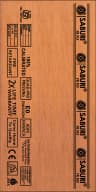
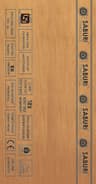
Fire-retardant plywood buys critical minutes during a fire — but 'fire-retardant' only means something when it's backed by testing: flame penetration, rate of burning, and recognised ratings like UL94 V0 and IS:5509. Here's how FR treatment actually works, how fire performance is measured in India, and what Saburi's Firewall protection adds.
How fire performance is rated
| Rating | What it measures | Applies to |
|---|---|---|
| IS:5509 | Minutes a panel resists flame penetration | Saburi FR Ply — 40, 60, 120 min |
| UL94 V0 | Seconds to self-extinguish once the flame is removed | Saburi Neowud NRFC |
Scroll the table sideways for every column.
What is the UL94 V0 fire rating?
Quick answer
UL94 V0 is the highest flammability classification under Underwriters Laboratories standards, requiring a panel to self-extinguish within 10 seconds of flame removal with no flaming drips and total burning time under 50 seconds across five test specimens. Saburi Neowud NRFC is UL94 V0 rated.
UL94 is the Underwriters Laboratories standard for flammability of plastic and composite materials. Five rating levels exist from lowest to highest: HB, V2, V1, V0, and 5VA/5VB. V0 — the rating achieved by Saburi Neowud NRFC — requires specimens to self-extinguish within 10 seconds after each of two 10-second flame applications, no flaming or glowing particle drips, and total flame time under 50 seconds across five specimens.
For building interior applications, UL94 V0 provides superior fire performance to IS:5509 FR plywood requirements for most occupancy categories. Unlike IS:5509 FR plywood where fire retardant chemicals are added to a combustible wood substrate, Neowud's UL94 V0 performance comes from its rice husk NRFC composition — the inherent chemistry provides fire resistance without added chemicals.
How does fire retardant treatment work in Saburi FR Ply?
Quick answer
Fire retardant chemicals are impregnated through veneer layers during manufacturing — not surface-applied. They raise the ignition temperature, create a protective char layer limiting oxygen access to unburned wood, slow flame spread, and reduce smoke density. IS:5509 certification confirms the treatment method and performance rating.
Fire retardant treatment in IS:5509 compliant plywood works through the chemistry of the impregnated chemicals rather than physical barrier alone. When FR-treated plywood reaches elevated temperatures: the fire retardant chemicals release water molecules (endothermic reaction) — absorbing heat and cooling the wood surface; phosphate or nitrogen-based compounds catalyse char formation at lower temperatures than untreated wood — the char layer insulates the unburned wood below from oxygen and further heat; volatile combustible gases are catalytically converted to less flammable forms rather than contributing to flame; and smoke-suppressing agents reduce visible smoke density and toxic combustion products. The result: ignition temperature rises, flame spread slows significantly, and smoke generation during combustion is substantially reduced.
The key difference between IS:5509 impregnation and surface coating: impregnated chemicals are distributed throughout the veneer depth and persist through the panel's life; surface-applied coatings burn away rapidly, exposing untreated wood within seconds of ignition.
How is fire resistance of plywood measured in India?
Quick answer
Fire resistance in plywood is measured by the time (in minutes) a panel resists flame penetration under standardised fire exposure per IS:5509. Saburi FR Ply offers 40, 60, and 120-minute ratings. For NRFC products, UL94 V0 (Underwriters Laboratories) is the applicable standard, measuring seconds to self-extinction.
Fire resistance measurement for plywood products in India uses two different standards depending on material type. For IS:5509 fire retardant plywood: flame penetration time is measured under standardised fire exposure conditions — the time from ignition until the fire front penetrates through the full panel thickness. This correlates to evacuation time available before structural barrier failure.
Saburi FR Ply's three ratings — 40 minutes, 60 minutes, 120 minutes — represent the panel's resistance under these standardised conditions. Test specimens are subjected to a standardised heat and flame exposure source, with temperature progression, smoke generation, and panel integrity monitored throughout. For NRFC composite products like Saburi Neowud: the UL94 standard is more appropriate given the polymer composite construction.
UL94 V0 measures seconds to flame self-extinction (must be within 10 seconds) — a different fire performance metric reflecting the material's self-extinguishing rather than penetration-resisting fire behaviour.
What is Saburi Ply's Firewall protection in Titanium Plus?
Quick answer
Firewall protection in Saburi Titanium Plus is an integrated fire-retardant treatment applied during manufacturing, in addition to the standard BWP marine-grade properties. It provides inherent fire resistance as a built-in feature — distinguishing Titanium Plus from standard BWP plywood without FR treatment.
Firewall protection in Saburi Titanium Plus represents an engineering integration that goes beyond standard BWP plywood specification — combining marine-grade moisture performance with inherent fire-retardant properties in a single premium panel. While standard Saburi BWP plywood (Gold 710, Scout BWP) provides boiling-water-proof moisture resistance without specific fire retardant treatment, and Saburi FR Ply provides fire-retardant treatment without the premium Gurjan core specification, Titanium Plus combines both: 100% Gurjan core (825 kg/m3 density, marine-grade performance), phenol-formaldehyde BWP bonding, QuadPro Technology, and Firewall protection (fire-retardant treatment integrated during manufacturing). This positions Titanium Plus as the single highest-specification plywood for luxury projects requiring both premium material quality and inherent fire resistance — without the need to specify a separate FR product for fire-sensitive applications within the same project.
Key takeaways
- Fire-retardant only counts when the chemicals are impregnated through the veneers during manufacture — a surface coating is not the same thing.
- Two different scales apply: minutes of flame resistance under IS:5509, seconds to self-extinction under UL94 V0.
- Titanium Plus carries Firewall treatment on top of its BWP marine properties, so fire resistance is built in rather than added.