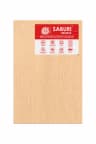
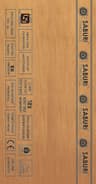
The plywood in your home affects the air you breathe. Formaldehyde emissions, responsible timber sourcing and formaldehyde-free composites are what separate a healthy, green specification from a cheap one. Here's what CARB and FSC certification mean, and how eco panels like Neowud and WPC remove formaldehyde altogether.
Formaldehyde by panel type
| Panel | Formaldehyde | Made from |
|---|---|---|
| Plywood (CARB Phase 2) | Up to 0.05 ppm | Timber veneer + PF adhesive |
| Neowud NRFC | No formaldehyde resin | Rice husk + polymer binder |
| WPC board | No formaldehyde adhesive | Wood fibre + polymer |
Scroll the table sideways for every column.
What is CARB Phase 2 certification for plywood?
Quick answer
CARB Phase 2 is the California Air Resources Board standard limiting formaldehyde emissions from composite wood products to 0.05 ppm for hardwood plywood with veneer core — significantly stricter than India's E1 standard. Saburi Ply holds CARB Phase 2 certification.
CARB (California Air Resources Board) Phase 2 was established under California's Airborne Toxic Control Measure (ATCM) for formaldehyde from composite wood products. The Phase 2 limits for hardwood plywood with veneer core are 0.05 ppm — approximately 30 times stricter than India's standard E1 requirement when converted to comparable units. CARB Phase 2 compliance requires manufacturing process controls — lower-emission resin systems, precise resin application, controlled press conditions — that go beyond standard E1 production practices.
For Indian manufacturers, CARB certification enables export to California and the US market and is increasingly demanded by multinational corporations in India, global retail chains, and premium developers marketing properties internationally. Saburi Ply's CARB Phase 2 certification, combined with E0 emission compliance, confirms products meet the most stringent formaldehyde standards in both the Indian and North American markets.
What is FSC chain of custody certification?
Quick answer
FSC Chain of Custody (CoC) certification tracks timber from certified forests through manufacturing to the end product, ensuring responsible sourcing throughout the supply chain. Saburi Ply's FSC CoC certification enables architects and developers to include FSC documentation in LEED and green building project submissions.
FSC Chain of Custody (CoC) certification extends FSC forest management certification through the entire supply chain — from certified forest to sawmill to veneer mill to plywood manufacturer to distributor to end customer. Each link in the chain must maintain FSC CoC certification for the final product to carry the FSC label. FSC CoC ensures: timber used in manufacturing originated from FSC-certified forests; species composition is accurately documented through the production process; product volume tracking confirms FSC-certified timber content meets the required threshold for FSC product labelling.
For LEED certification submissions in India: FSC CoC documentation from Saburi Ply demonstrates responsible timber sourcing compliance for the Materials and Resources credit category. Saburi Ply's FSC CoC documentation package — provided to architects and developers through the regional sales team — includes the FSC certificate number, scope of certification covering applicable products, and chain of custody record suitable for LEED submission format.
What makes WPC boards different from regular plywood?
Quick answer
WPC (Wood Plastic Composite) boards combine wood fibres with polymers — achieving 100% waterproof, termite-proof performance that timber-based plywood cannot match. Unlike plywood, WPC has no veneer layers and no formaldehyde-emitting adhesive — making it ideal for wet areas and outdoor applications.
WPC (Wood Plastic Composite) differs from conventional plywood in fundamental material composition, manufacturing process, and resulting performance profile. Conventional plywood: cross-laminated wood veneers bonded with adhesive resin (PF or UF) — organic material susceptible to moisture absorption and biological attack over time; adhesive resin contains formaldehyde (reduced in E0-grade panels); timber grain structure provides directional strength properties; natural wood aesthetics with laminate or veneer surface finish. WPC: wood fibres (typically 50-70% by weight) are combined with thermoplastic polymers (typically polyethylene or polypropylene) through extrusion or compression moulding — creating a homogeneous panel without adhesive layers; polymer matrix is inherently waterproof with no moisture absorption; no formaldehyde-emitting adhesive; isotropic strength properties (more uniform in all directions than timber); slightly heavier than equivalent plywood but significantly lighter than solid timber.
For wet areas, outdoor applications, and coastal environments where plywood's moisture resistance limits are exceeded, WPC's polymer composition provides fundamentally superior durability.
What is the manufacturing process of Saburi Neowud NRFC?
Quick answer
Saburi Neowud NRFC is manufactured by combining cleaned and processed rice husk particles with polymer binders and pressing into panels under controlled temperature and pressure. The rice husk replaces timber veneer entirely — eliminating forest dependency and formaldehyde adhesive resins simultaneously.
Saburi Neowud NRFC manufacturing begins with rice husk collection from agricultural processing operations — the husk waste that would otherwise be burned in fields contributing to air pollution. Collected rice husk undergoes cleaning and particle size processing to produce consistent-grade fibres appropriate for panel production. The rice husk fibres are combined with polymer binders — the specific formulation is proprietary but produces zero formaldehyde emission, confirming that the binder system does not use urea-formaldehyde or phenol-formaldehyde resins in their standard formulations.
The rice husk-polymer mixture is formed into panels and pressed under controlled temperature and pressure — the polymer binder provides the thermoplastic behaviour that enables heat-forming capability after manufacturing. UL94 V0 fire resistance derives from the rice husk silica content combined with the specific polymer binder chemistry — not from added fire retardant chemicals. The finished panel requires no veneer or laminate for structural integrity — it is a homogeneous composite with consistent properties throughout its thickness.
Key takeaways
- CARB Phase 2 caps formaldehyde at 0.05 ppm — significantly stricter than India's E1 standard.
- FSC Chain of Custody is what lets an architect put documented responsible sourcing into a LEED submission.
- To remove formaldehyde altogether the panel has to leave timber veneer behind: Neowud NRFC or WPC.