
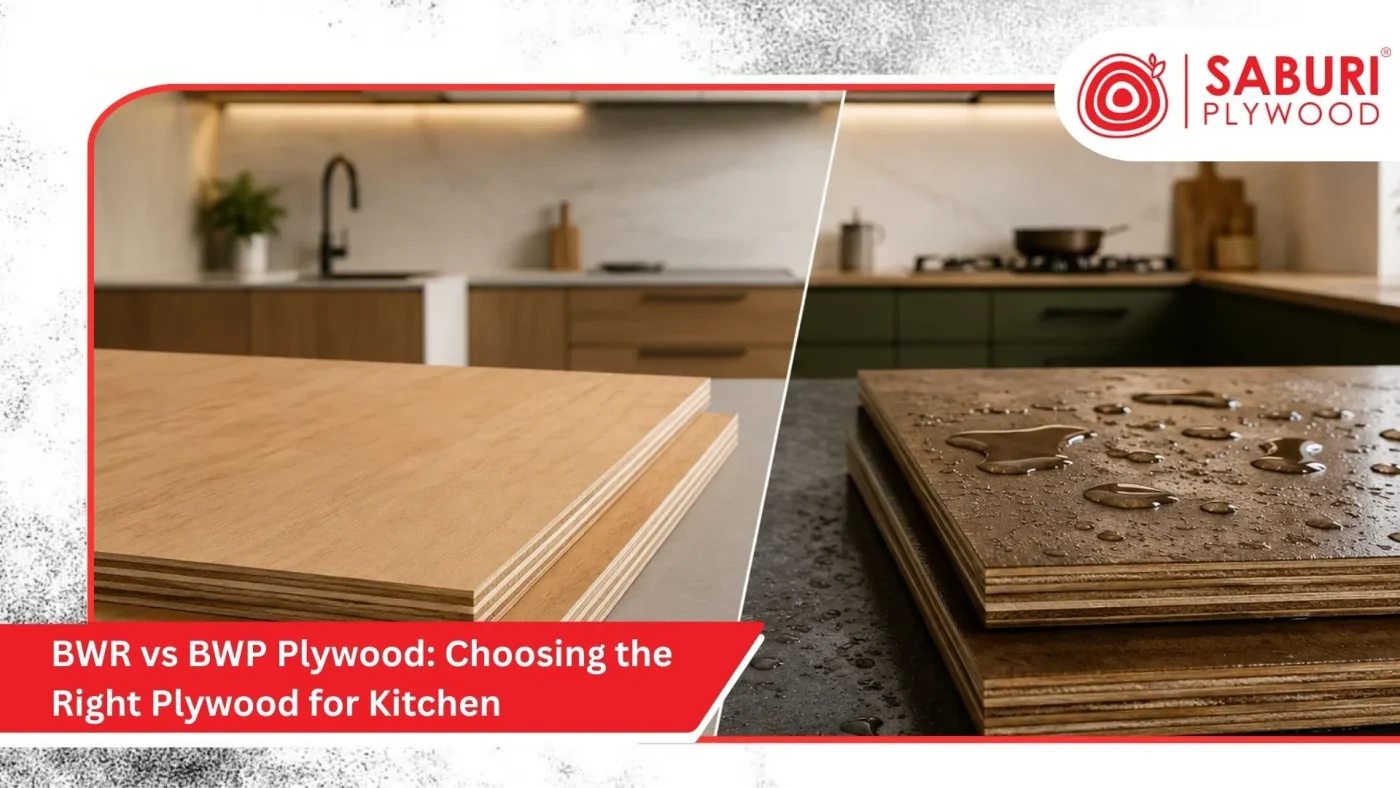

If you are building or renovating a kitchen, the BWR vs BWP plywood question will come up sooner or later. Most carpenters will mention one or the other without explaining why. This guide explains the difference in plain language, so you can decide based on what your kitchen actually needs, not what sounds impressive.
Why Kitchen Plywood Cannot Be a Casual Choice
A kitchen sees more daily stress than any other room in the house. Steam from cooking. Water splashes near the sink. Spills that sit on the cabinet base for hours before anyone notices. Heat from the stove side. None of this is occasional. It happens every single day, for years.
Plywood that is not built for this environment starts showing signs early. The base of the sink cabinet swells first. Door edges curl. Shelves inside start smelling musty. By the time you notice, the damage is already done, and replacing a cabinet is far more expensive than choosing the right board the first time.
This is why plywood for kitchen use needs a different grade than plywood for a bedroom wardrobe or a study table. At Saburi Plywood, this is exactly the thinking behind how our BWR and BWP ranges are built, each suited to a different level of moisture exposure, from everyday humidity to constant water contact.
What BWR Plywood Actually Means
BWR stands for Boiling Water Resistant. It is tested by boiling a sample of the board and checking how well the layers hold together afterward.
BWR plywood is built to handle regular humidity and occasional water contact. Think steam from cooking, condensation on a cold morning, or a quick splash that gets wiped off soon after. It performs reliably in these conditions for years.
What BWR plywood is not built for is constant standing water. If your kitchen design has a section that stays wet for long periods, like directly under the sink pipe, BWR ply alone is not the right call there.
This is where most homeowners get confused. BWR ply is often marketed as fully waterproof, which it is not. It is water resistant. That difference matters when you are deciding where in the kitchen to use it. Saburi’s BWR plywood range is certified under IS 303, so the resistance level is tested and confirmed, not just assumed.
What BWP Plywood Actually Means
BWP stands for Boiling Water Proof. The testing standard is tougher. The board is boiled for a longer duration, and to pass, the layers must show no separation, no bubbling, and no loss of bonding strength.
BWP plywood is built for sustained water exposure. The area right under the sink, the wet zone near the chimney, and the cabinet base in a kitchen that gets washed with water regularly are all places where BWP earns its place.
If you are asking which grade to choose for the wet zones of your plywood for kitchen plan, BWP is almost always the safer answer. Saburi Gold, our flagship BWP range, is certified under IS 710 and built specifically for this kind of sustained moisture exposure.
BWR vs BWP Plywood: The Practical Difference
| Feature | BWR Plywood | BWP Plywood |
|---|---|---|
| Full Form | Boiling Water Resistant | Boiling Water Proof |
| BIS Standard | IS 303 | IS 710 |
| Water Resistance | Handles humidity and occasional water exposure | Withstands prolonged water exposure and wet conditions |
| Adhesive Used | Melamine Urea Formaldehyde (MUF) Resin | Phenol Formaldehyde (PF) Resin |
| Boiling Water Test | Resists boiling water for a limited duration as per IS 303 | Designed to withstand extended boiling water tests as per IS 710 |
| Best Applications | Kitchen wall cabinets, wardrobes, study tables, office furniture | Sink cabinets, kitchen base cabinets, bathrooms, utility areas |
| Suitable for Humid Areas | ✔ Yes | ✔ Yes |
| Suitable for Constant Water Contact | ✖ No | ✔ Yes |
| Durability | High | Very High |
| Cost | More affordable | Premium due to higher water resistance |
| Warranty (Saburi) | Varies by product range | Up to 30 Years (Saburi Gold) |
| Recommended For | Dry and moderately humid spaces | Wet zones and high-moisture environments |
Here is the simplest way to think about BWR vs BWP plywood. BWR handles humidity and occasional wetness. BWP handles standing water and sustained moisture.
A smart kitchen design often uses both. BWR for the upper cabinets, the dry storage units, and areas away from water. BWP for the base cabinets, the sink unit, and anywhere water collects or splashes regularly.
Using BWP everywhere is not wrong, but it usually is not necessary either. The dry sections of your kitchen do not need the same level of protection as the wet ones. Knowing where to use which grade saves money without compromising on durability where it actually counts. This is the kind of practical guidance our team at Saburi Plywood gives dealers and homeowners every day.
Understanding BWP Plywood Price Before You Buy
BWP plywood price is generally higher than BWR, and this is for a good reason. The manufacturing process for BWP involves stronger adhesive, often phenol formaldehyde, and a more rigorous pressing and calibration process to meet the boiling water proof standard.
When comparing BWP plywood price across brands, do not look at the number alone. Look at what is backing that price. A board with a longer warranty, a recognised BIS certification under IS 710, and a transparent core material disclosure is worth paying slightly more for, because it is the board protecting your kitchen investment for the next fifteen to thirty years. Saburi Gold, for instance, carries a 30 year warranty under IS 710, which gives you a clear sense of what you are actually paying for.
A lower BWP plywood price that comes without proper certification or warranty is not a saving. It is a risk deferred to later.
What to Check Before You Finalise
Before you settle on either grade, check these three things.
Core Baterial
Ask what wood is inside the board. A denser hardwood core holds screws better and resists wear longer, especially in a kitchen where cabinets get opened and closed hundreds of times a month. Saburi uses hardwood core in its Scout BWR plywood range, and Eucalyptus hardwood core with Okume face veneer in its Gold BWP range, with Gurjan core reserved for its structural grade ranges.
ISI Certification
Genuine BWR plywood is certified under IS 303. Genuine BWP plywood is certified under IS 710. Ask for the CML number. It confirms the board has actually been tested, not just labelled.
Warranty Terms
A brand confident in its BWP or BWR plywood will offer a clear, written warranty. Vague promises without a specific number of years are a signal to ask more questions.
Where Saburi Ply Fits Into Your Kitchen Plan
At Saburi Plywood, we manufacture both BWR and BWP grades under certified IS standards, with hardwood cores selected for each range, and calibration that keeps every sheet uniform in thickness. Our Saburi Gold range, built to IS 710, is engineered specifically for kitchens, wardrobes, and any space exposed to regular moisture, while our Scout BWR range is built for everyday furniture needs across the home.
If you are not sure which grade your kitchen layout actually needs, get in touch with us. We will help you figure out exactly where BWR works and where BWP is worth the extra spend, so your kitchen is built right the first time.
Leave a Comment