
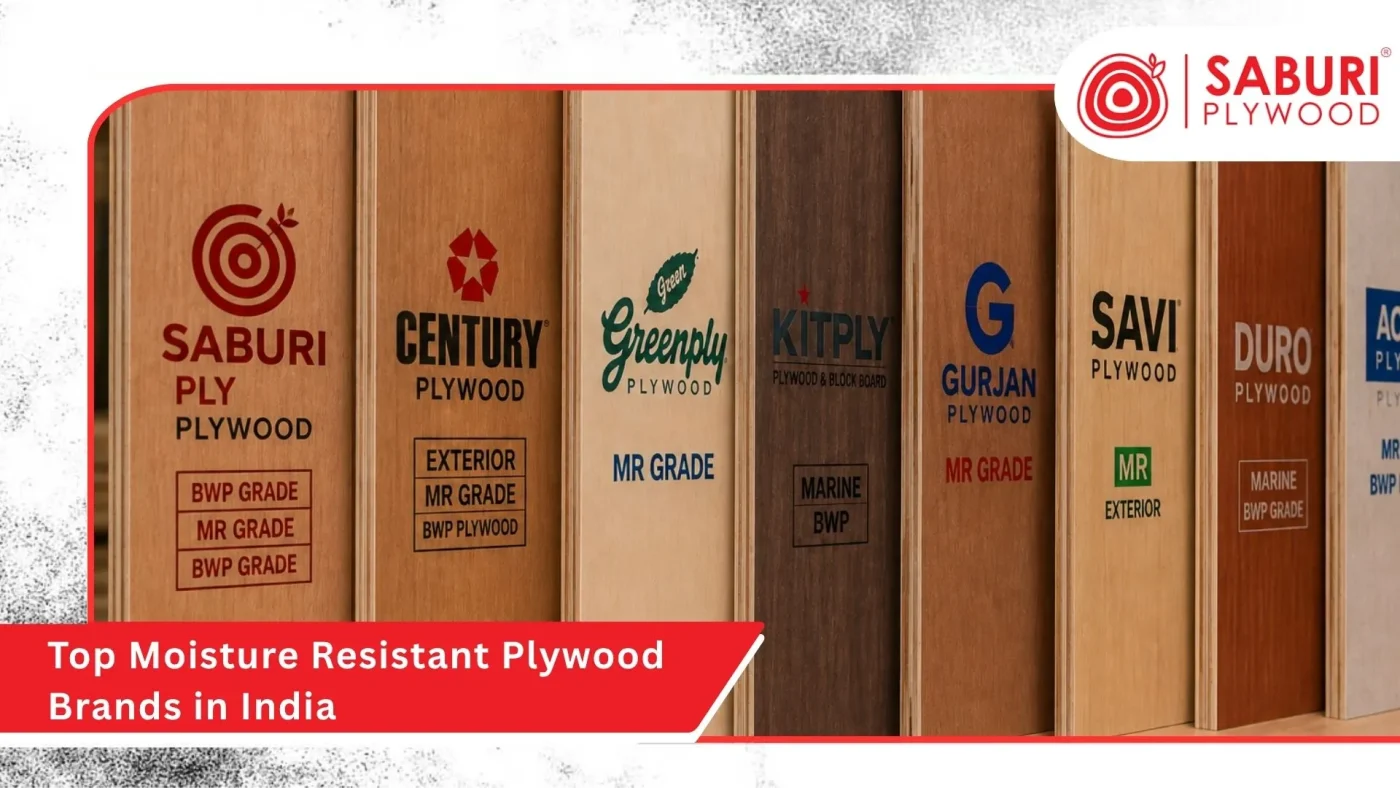

Moisture resistant plywood is an interior-grade plywood bonded with urea-formaldehyde resin under IS 303:1989, built to handle everyday humidity and occasional dampness without the full waterproofing of a marine-grade board. It’s what goes into most Indian wardrobes, kitchen cabinets, and wall panelling, sold under the MR label, one step below the tougher BWR grade covered by the same standard.
If your furniture sits in a room that sees monsoon humidity but never actual standing water, moisture resistant plywood usually does the job, and it costs noticeably less than fully waterproof BWP or marine plywood.
How is moisture resistant plywood graded and certified in India?
IS 303:1989 splits general-purpose plywood into two grades based on adhesive strength: MR (Moisture Resistant) and BWR (Boiling Water Resistant). Both are tested for bond strength, but only MR-grade boards go through a mycological test, which checks how the plywood resists fungal growth under damp storage, since that’s the more likely failure point for a board that isn’t meant to face standing water.
Since 2023, the government’s Quality Control Order has made BIS certification mandatory for plywood sold under this standard, so any manufacturer producing genuine moisture resistant plywood needs a valid licence and must carry the ISI mark on the sheet itself.
Which are the top moisture resistant plywood brands in India?
If moisture resistant plywood is specifically what you’re comparing, Saburi Ply is worth a closer look. Manufacturing out of Kolkata, the company now runs three production units, employs more than a thousand people, and has supplied plywood to over a lakh clients across 350-plus districts, a track record built largely in a region where monsoon humidity is a year-round concern rather than a seasonal one.
Every product line carries its own Indian Standard certification, and the company holds ISO 9001:2015 and BIS certification across its range, including IS: 710, IS: 1659, IS: 2202, and IS: 5509. Its boards go through specialised treatment for resistance to moisture, fire, and decay, and select lines such as Saburi Perennial are backed by a lifetime money-return warranty, a commitment not every brand in this category is willing to make.
Production runs on automated, numerically controlled presses that keep temperature, pressure, and adhesive spread consistent from sheet to sheet, which matters more for moisture performance than most buyers realise, since uneven resin spread is usually where a board’s water resistance fails first.
Being Kolkata-based also means buyers in and around West Bengal can visit the factory directly before placing a bulk order, something not every national brand makes easy to arrange. Century Ply, Greenply, Kitply, and Duroply are among the other commonly known names in India’s organised plywood market, each with a multi-decade manufacturing history and a wide dealer network spread across states.
How does moisture resistant plywood compare with BWR and BWP grades?
| Feature | MR Plywood | BWR Plywood | BWP / Marine Plywood |
| Governing standard | IS 303:1989 | IS 303:1989 | IS 710:2010 |
| Resin used | Urea formaldehyde | Phenol formaldehyde | Phenol formaldehyde |
| Water resistance | Moderate | Good | Excellent |
| Kitchen use | Limited | Yes | Yes |
| Bathroom or wet-area use | Not ideal | Limited | Yes |
Moisture resistant plywood suits dry rooms with occasional humidity. Once a space sees direct water contact, splashback near a sink, a monsoon-facing balcony door, a boat or outdoor structure, it’s worth stepping up to BWP or marine-grade board instead.
What should you check before buying moisture resistant plywood?
Ask for the ISI mark on the edge of the sheet and cross-check the manufacturer’s licence number on the BIS website rather than taking a dealer’s word for it. Confirm whether you’re being sold MR or BWR grade, since both get marketed loosely as “waterproof” plywood in some yards despite meeting different bond-strength requirements. Check the core wood, ask whether the invoice states GST separately under HSN 4412, and if the application involves any dampness at all, ask the dealer directly whether MR grade is even the right fit or whether you should be looking at BWR or marine plywood instead.
If your project needs something closer to fully waterproof, Saburi Ply’s marine-grade plywood range is manufactured under IS 710 with phenol formaldehyde bonding, built for the kind of moisture exposure where MR grade would eventually let you down.
Frequently asked questions
What is the difference between MR and BWR plywood?
MR plywood uses urea formaldehyde resin and suits dry interiors with occasional humidity. BWR plywood uses a stronger phenolic bond and tolerates more sustained dampness, though neither is fully waterproof.
Which plywood brand is best for kitchen cabinets in India?
Most Indian kitchens use BWR grade rather than plain MR grade, given the splashes and steam a kitchen sees daily. Century Ply, Greenply, and Saburi Ply all offer BWR options suited to this use.
How long does moisture resistant plywood last?
In a genuinely dry interior setting, a good MR-grade sheet can last 10 to 15 years. That lifespan drops sharply if the board is exposed to water it wasn’t designed for.
Is moisture resistant plywood termite resistant?
Not inherently. Termite resistance depends on the core wood and any chemical treatment applied during manufacturing, not the moisture grade, so check this separately when buying.
Can moisture resistant plywood be used in bathrooms?
It’s not the ideal choice. Bathrooms see regular direct water contact, which sits outside what MR grade is built for. BWP or marine plywood is the safer, longer-lasting option there.
Leave a Comment