
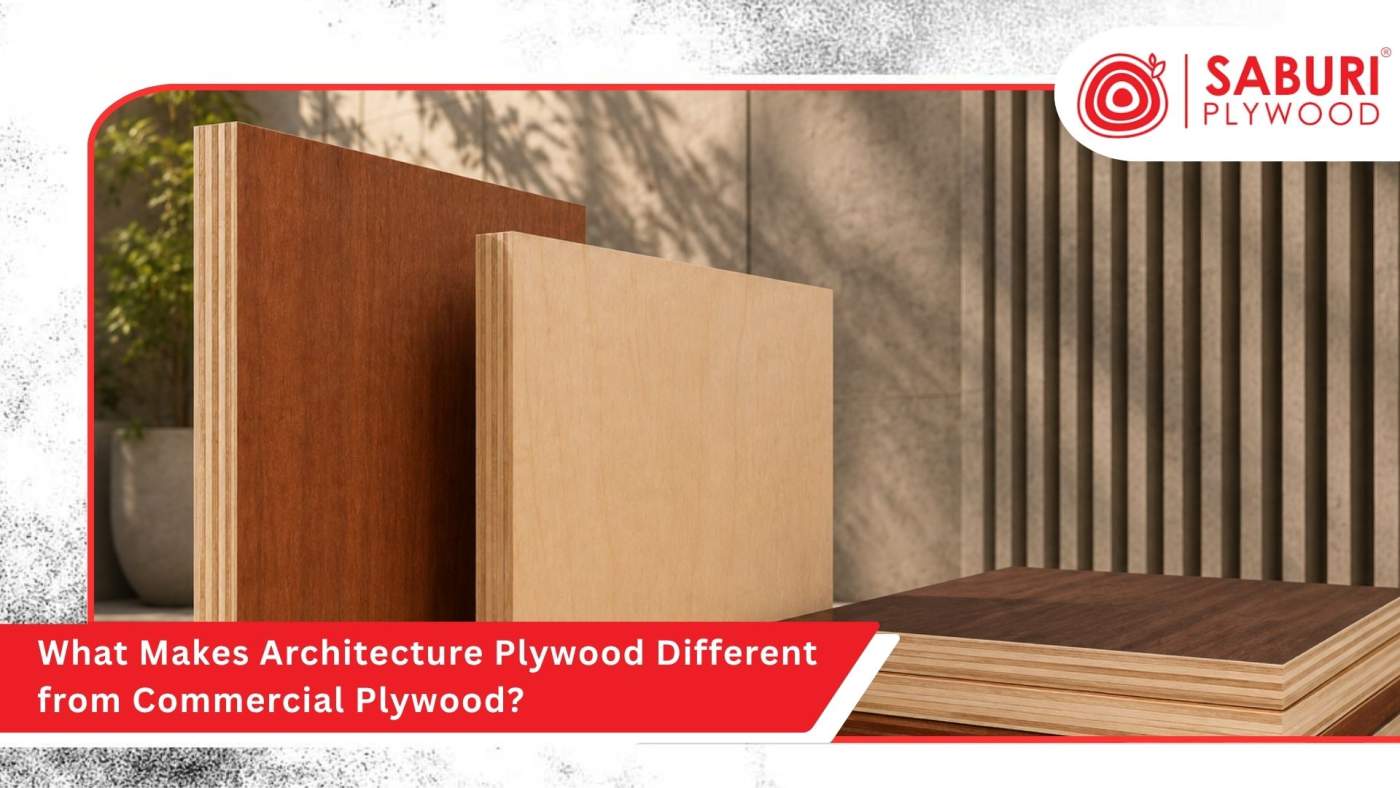

Architecture plywood is a trade term, not an official grade. It refers to premium boards built to the tighter standards that architects and interior designers ask for. That usually means calibrated thickness, a gap-free Gurjan hardwood core, phenol-formaldehyde bonding, and a stronger warranty than standard board carries.
MR, BWR, and BWP are the real government-defined grades under IS: 303. Architecture plywood isn’t one of them. It’s simply the term manufacturers use for their top structural product line, built for projects where the finish and the fit of every joint matter as much as the price. Commercial plywood is different. It’s the everyday MR-grade board sold in almost every timber yard in India, built for budget-friendly interior work rather than exacting site conditions.
How is Architecture-Grade Plywood Manufactured Differently From Commercial Plywood?
The gap starts at the core. Commercial-grade board is often built from mixed or lower-density veneers with small overlaps and voids that don’t show up until a screw won’t hold or a laminate starts lifting at the edge. Architecture-grade plywood uses a gap-free hardwood core, typically Gurjan, pressed under closer quality control so there’s no hollow spot hiding under the face veneer.
Calibration is the other big difference: architecture plywood is machine-sanded to a consistent thickness across the entire sheet, which is what lets cabinet doors sit flush and laminate bonds evenly. Commercial plywood usually skips this step, since the cost saving matters more than the finish for its typical use case.
What is Commercial Plywood Actually Built for?
Commercial plywood is interior-grade board bonded with urea-formaldehyde resin under the MR classification of IS: 303, designed for dry rooms with only occasional humidity. It’s what goes into budget wardrobes, shelving, and everyday furniture where the board won’t face direct water contact or heavy structural load.
It’s genuinely a reasonable choice for the right application. The trouble starts when it gets used somewhere it was never built for, a kitchen sink unit or a bathroom vanity, where the resin simply isn’t rated to hold up.
How Does Architecture-grade Plywood Compare with Commercial plywood on Paper?
| Feature | Commercial (MR) Plywood | Architecture-Grade Plywood |
| Resin used | Urea formaldehyde | Phenol formaldehyde |
| Core | Mixed or softwood, may have gaps | Gap-free Gurjan hardwood |
| Calibration | Usually not calibrated | Machine-calibrated |
| Water resistance | Moderate | Excellent (BWP or marine grade) |
| Typical warranty | Standard | Extended or money-back |
Why Do Architects and Interior Designers Specify Architecture Plywood Over Commercial Grade?
Specification comes down to accountability. When an architect signs off on a material for a client’s kitchen or a commercial fit-out, the plywood needs to perform for decades without a callback, and that’s exactly the gap architecture-grade board is built to close.
Saburi Ply’s Titanium Plus range is a useful example of what this tier actually looks like in practice: a Gurjan hardwood core, automated calibrated production for consistent thickness, and a warranty structure backed by a tenfold money-back guarantee for life, a commitment few manufacturers extend to a single product line.
That kind of warranty only makes commercial sense if the manufacturer is confident the board performs exactly as specified, sheet after sheet, which is the entire point of paying more for architecture-grade plywood in the first place.
What Should You Check Before Paying for Architecture-Grade Plywood?
Ask for the CML number on the panel edge and check it against the Bureau of Indian Standards portal before you place a bulk order. Confirm the warranty terms in writing rather than taking a dealer’s verbal assurance, since “lifetime warranty” can mean very different things depending on what voids it.
Run a hand across the sheet to feel for calibration. Genuine architecture-grade plywood should feel perfectly flat with no thickness variation across the panel. And make sure GST is shown separately under HSN 4412 so you’re comparing quotes on equal footing.
If your project needs the fully waterproof end of this range, Saburi Ply’s marine-grade plywood is built to IS: 710 for exactly the kind of demanding, moisture-heavy applications where commercial-grade boards would fail.
Frequently asked questions
Is architecture plywood the same as BWP plywood?
Not exactly. Architecture-grade plywood is usually built to BWP or marine-grade water resistance, but the term also covers calibration, core quality, and warranty terms that BWP alone doesn’t guarantee.
Is commercial plywood waterproof?
No. Commercial plywood resists humidity but isn’t built for direct water contact. Kitchens and bathrooms need BWR or BWP grade instead.
What is calibrated plywood?
Calibrated plywood is machine-sanded to a uniform thickness across the entire sheet, so cabinet joints fit flush and laminate bonds evenly, unlike uncalibrated boards which can vary in thickness within the same panel.
Which plywood do interior designers recommend for premium projects?
Most designers specify architecture-grade or BWP-and-above plywood with a Gurjan core for visible, load-bearing, or moisture-prone areas, reserving commercial grade for hidden, dry-interior work only.
How long does architecture-grade plywood last compared to commercial plywood?
A genuine architecture-grade sheet can last 20 years or more with proper installation, against roughly 8 to 12 years for commercial-grade boards in similar conditions.
Is architecture-grade plywood worth the extra cost for a home?
For kitchens, bathrooms, and any load-bearing furniture, yes, since the replacement and repair cost of failed commercial-grade boards usually exceeds what the upgrade would have cost. For dry storage or low-visibility areas, commercial grade remains a sensible choice.
Leave a Comment