
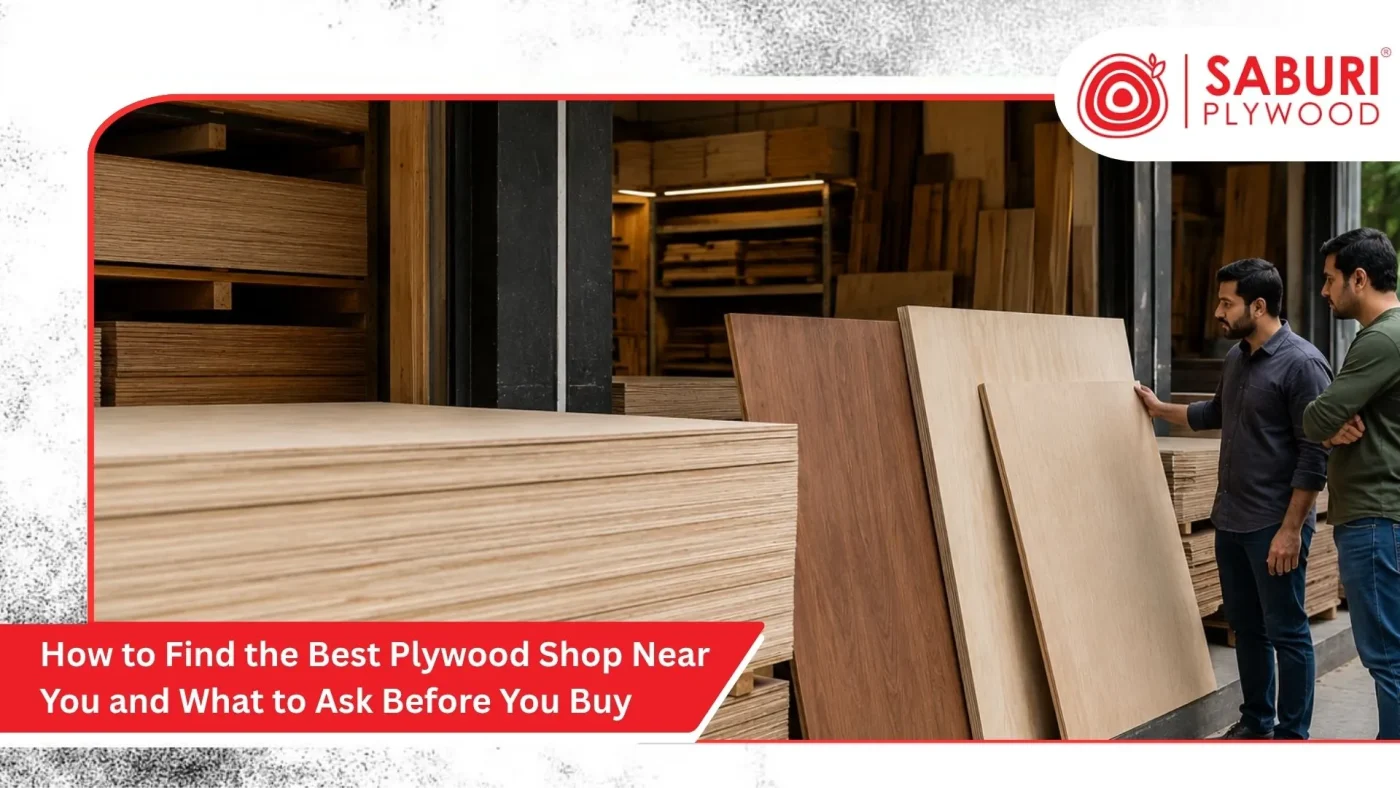

You’ve decided to renovate your home or build new furniture. The carpenter hands you a list. “Get 18mm plywood, BWR grade, 8×4 sheets. You type “plywood near me” into Google, pick the first result, walk in, and trust the shopkeeper to guide you.
Here is where most homeowners lose money.
Not because the shop is dishonest, but because they don’t know the right questions to ask. The shopkeeper, understandably, sells what’s in stock.
This guide will change that. By the end, you’ll enter any plywood shop near you knowing exactly what to ask, what to check, and what to avoid.
Why Finding the Right Plywood Matters More Than Finding the Nearest Shop
When you search for a “ply shop near me,” being close feels like the most crucial factor. It isn’t.
The most important factor is whether the shop has ISI-certified plywood from a manufacturer you can verify. Here’s why this matters: India’s plywood market is about 70% unorganized. This means most plywood sold across the country, even by reputable-looking shops, may come from small, uncertified manufacturers. It may look identical to certified plywood, but it is not.
Uncertified plywood warps within two years. It delaminates when exposed to humidity. Termites easily find it. Your wardrobe, kitchen cabinets, and children’s study table all depend on the quality of this one material choice.
So yes, find a plywood shop near you, but then ask the right questions when you get there.
The Three Grades Every Homeowner Must Know
Before you go into any shop, understand these three grades. They determine how your furniture holds up over the years.
MR Grade (Moisture Resistant) is the most affordable option. It handles normal indoor humidity reasonably well but is not suitable for kitchens, bathrooms, or areas with potential water exposure. Use it for bedroom wardrobes in dry climates only.
BWR Grade (Boiling Water Resistant — IS:303) is the standard recommendation for most Indian homes. It withstands humidity, indirect water exposure, and the temperature changes of Indian summers. This is what most carpenters mean by “good plywood.” Look for the IS:303 certification mark.
BWP Grade (Boiling Water Proof — IS:710) is the premium waterproof grade. The Saburi Gold 710, for instance, comes with a 30-year warranty because it truly resists full water immersion. This is what your kitchen cabinets, bathroom vanity, and outdoor furniture need. Do not compromise here.
The Skill Blindspot: The One Question Nobody Asks
Here is something most homeowners never think to check, and it is a costly mistake in furniture making.
Ask: “Is this plywood calibrated?”
Calibrated plywood means every sheet has been cut to a uniform, consistent thickness. Uncalibrated plywood, even if it is labelled 18mm, can vary between 16.5mm and 19mm across different sheets in the same batch.
Why does this matter? Your carpenter builds your kitchen or wardrobe, assuming every sheet is exactly 18mm. When sheets vary, the joints don’t align, gaps appear in the finished furniture, hinges don’t sit flush, and drawers don’t close correctly. The carpenter fills these gaps with extra wood or putty, making the furniture look slightly off. It also loosens faster.
Most homeowners blame the carpenter. The problem was the plywood.
Calibrated plywood costs a bit more but saves you significantly in labour and frustration with furniture that never looks quite right. When you visit your plywood shop, ask this one word: “Calibrated?”
If the shopkeeper looks uncertain, that tells you everything.
What to Check When You’re at the Shop
Once you’ve found a plywood shop near you and you’re standing in the shop, go through this checklist:
Look for the ISI mark. Every sheet of certified plywood carries a Bureau of Indian Standards (BIS) ISI mark stamped on the edge. It should include the IS number (IS:303 for BWR and IS:710 for BWP), a license number, and the manufacturer’s name. If any of these are missing or printed in a font that smudges easily, it is almost certainly a fake certification.
Check the edges. A cross-section of the edge tells you the quality of the core. Good plywood has tight, uniform layers with minimal gaps. Voids or empty spaces between layers tend to weaken the board significantly. Run your eye along the edge of the sheet before you agree to buy.
Ask for the manufacturer’s warranty documentation. Reputable manufacturers like Saburi Ply provide product warranties. BWP-grade plywood should come with a documented warranty of at least 10 to 30 years, depending on the product line. If no warranty documentation exists, the product may not be what it claims to be.
Verify the brand. Anyone can print a label. Before you buy, search the manufacturer’s name online. A legitimate manufacturer has a website, a verifiable address, ISI license numbers on their site, and a dealer network you can check. Saburi Plywood Pvt. Ltd., for example, lists its certifications, product specifications, and authorised dealer network publicly at saburiply.com.
How Much You Should Spend?
The price depends on the city, the grade and the thickness. As a general reference for ISI-certified plywood in India:
For BWR and MR grade 18mm (8×4 sheets), expect to pay between ₹1,100 and ₹1,600 per sheet, depending on brand and city. For BWP grade 18mm, expect ₹1,400-₹2,200 per sheet. If the price is outside of these ranges in either direction, it should be questioned. Too low generally indicates uncertified material and too high may indicate excessive markup.
Always ask for a written invoice that clearly states the brand name, grade and thickness, which protects you if the material needs to be returned or replaced under warranty.
Before You Leave the Shop
You came in searching for a plywood shop near me. You found one. Now leave with this:
– Grade confirmed (BWR or MR or BWP depending on application)
– ISI mark verified on the sheet edge
– Calibration confirmed
– Manufacturer verified online
– Written invoice with grade and specifications
This five-point check takes less than ten minutes. It is the difference between furniture that lasts twenty years and furniture that disappoints you in three.
Leave a Comment